FinOps Cost Management
Qarion's FinOps module gives data teams and finance stakeholders granular visibility into the cost of running data products, querying warehouses, and operating third-party tools.
It bridges the gap between raw billing usage (warehouse compute, storage) and logical business ownership (Data Domains, Data Products).
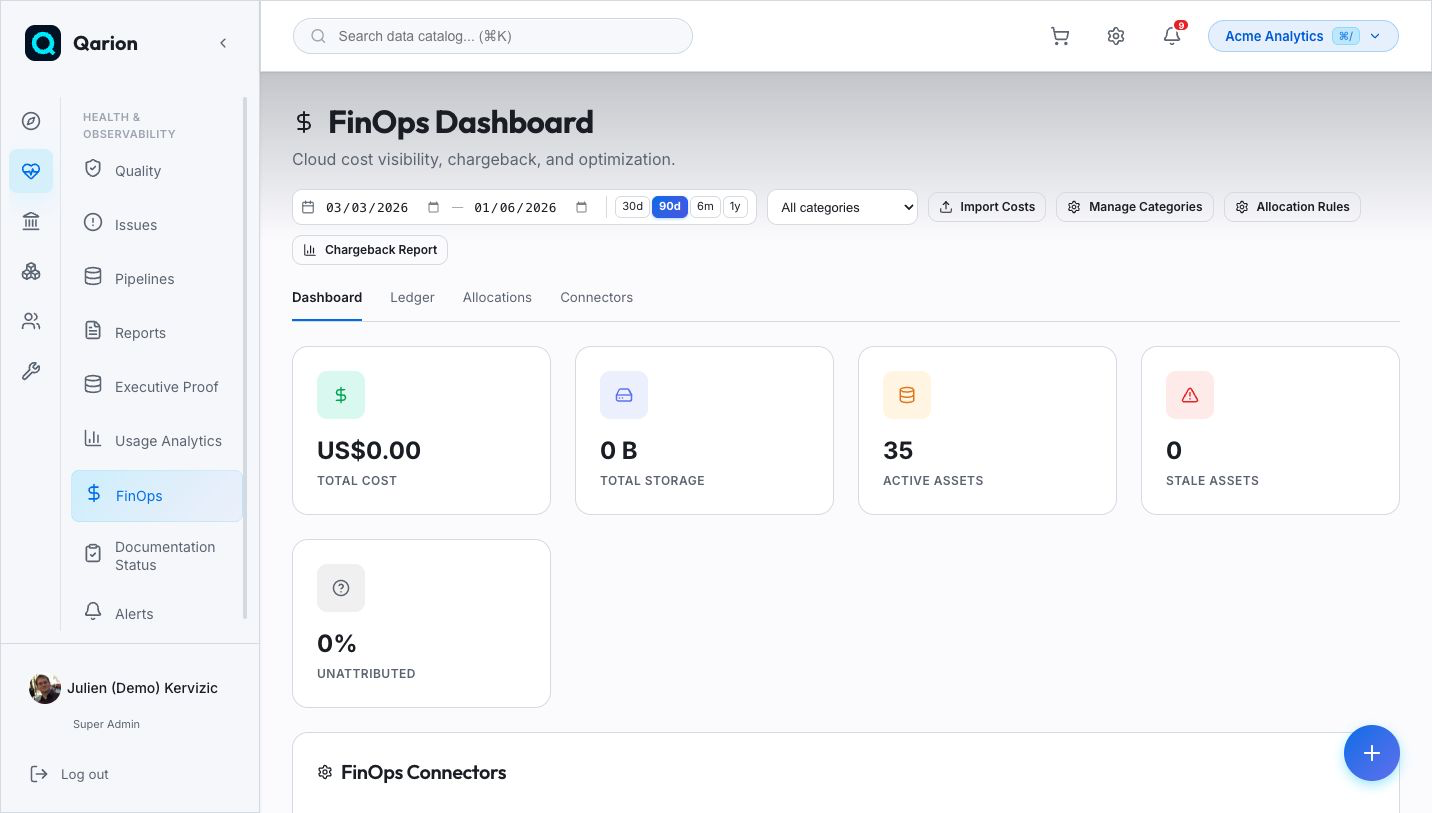
Features
Dashboard Cost Visibility
The core FinOps Overview provides a unified ledger of all costs attributed to data products. This view aggregates:
- Warehouse Usage: Compute cost, query volume, and storage derived directly from connectors (Snowflake, BigQuery, Postgres).
- Manual Import Costs: Ad-hoc or offline costs mapped manually to specific products.
In the current platform version, automated warehouse metric ingestion (like Snowflake Credits, BigQuery Scanned Megabytes, or Databricks DBUs) maps symmetrically (1:1 scale) to the dashboard's USD currency presentation. Because there is currently no intermediate Cloud Pricing Catalog (e.g., $2.00/credit rate multiplication), native dashboard reporting will reflect raw volumetric scale rather than true cross-multiplied USD calculations. Fully monetized billing strings derived from AWS CUR or Azure Cost Management APIs are scaled precisely to 1,000,000 micro_cents for accurate ledger balancing.
You can sort your entire asset inventory by Allocated Cost to easily identify your most expensive data products.
Cost Anomaly Detection
By tracking standard baseline behaviors and historical trends, the FinOps engine automatically flags runaway queries or unexpected cost spikes. The system strictly isolates and monitors standardized FINOPS_METER_KEYS to avoid raising false alarms on generic platform-telemetry, ensuring all anomalies definitively represent a drift in downstream financial metrics. When anomalous usage patterns are detected on a Data Product:
- A
CostAnomalyAlertis triggered. - A red
TrendingUpAnomaly Badge appears directly in the FinOps dashboards. - Notifications can be dispatched through the standard Alert Management routines.
Domain-Level Chargeback Reports
To facilitate department-level chargebacks, the Chargeback & Reports tab automatically attributes costs at the Data Domain scale. Qarion merges direct data product costs with broad domain-level manual entries perfectly into an Activity-Based Costing framework, allowing you to generate comprehensive chargeback reports visually translated via intuitive pie charts.
Manual Cost Import
Beyond the automated billing pipelines, the platform supports manual ingestion of infrastructure costs (e.g., custom SaaS licenses, external consulting fees, support plans). You can import these expenses via:
- Individual Form Entry: For singular ad-hoc costs.
- Bulk CSV Upload: Drag-and-drop a CSV directly into the workspace to ingest hundreds of historical costs simultaneously. The ingestion engine features strict safety constraints ensuring that identically-dated recurrent costs of differing amounts are individually preserved without data loss.
Cost Allocation Rules
The key to an accurate chargeback is defining how unattributed or shared costs are allocated to specific products. You can create rules using four distribution strategies:
- Even Split: Distributes the cost equally across all applicable assets.
- Proportional Storage: Allocates cost relative to each product's stored bytes.
- Proportional Queries: Allocates cost based on query volume execution.
- Custom Weights: Allows fine-grained ratio tuning (e.g., 60% to Product A, 40% to Product B).
Allocation logic can also automatically parse and bind costs using explicit Cloud tags mapped back to Qarion entity UUIDs.